
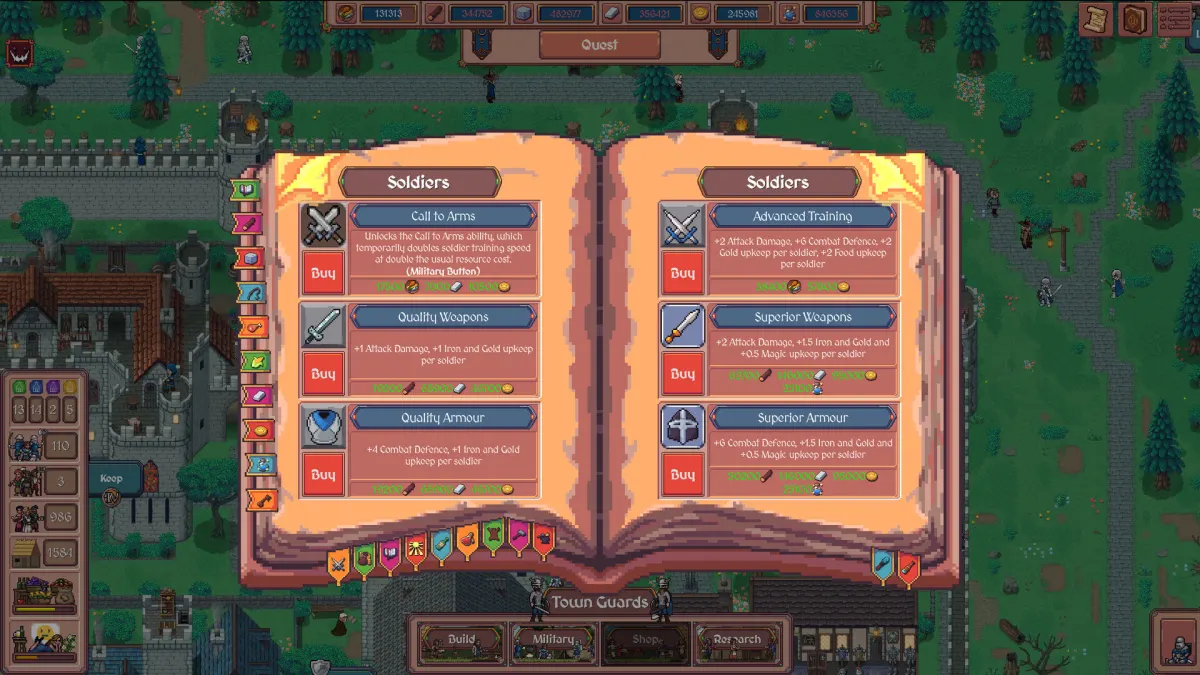
Research system overview
Research is the long-term progression layer in Hearth and Hamlet. The official Steam description says upgrades feed into a research tree that permanently unlocks new technologies, including buildings, policies, magic, and other upgrades as your civilization advances.
That makes research different from a short-lived production boost. An unlock expands what the settlement can do for the rest of the run, so the best early choices are the ones that remove a current economic bottleneck or open a system you can use immediately.
Plan around outcomes, not tier labels. Official sources confirm a multi-branch research system but publish no node list or tier order. A community wiki has catalogued 323 research entries from build 1.0.04 — the named nodes below come from that catalogue, and the 1.0.05 and 1.0.06 patch notes announced no research-tree changes. Confirm exact costs in your in-game panel.
Confirmed branch themes
The official Steam material does not publish a complete node list, but it names the themes the research tree permanently unlocks. The table below separates what is officially confirmed from what remains unspecified.
| Theme | What the official page confirms | Not yet documented publicly |
|---|---|---|
| Advanced architecture | Named as a permanent unlock category of the research tree. | Individual building unlocks and their prerequisites. |
| Civic policies | Laws and policies, taxation rules, worker rules affecting morale, city guard drafts. | Exact morale and income math per policy. |
| Alchemy | Alchemical labs are part of the advanced building system. | Lab tech prerequisites and crafting costs. |
| Magic | Magical academies unlock mid-to-late game automation and resource transmutation spells. | Spell list, casting costs, and academy requirements. |
| Trade | Trade routes with neighbouring kingdoms and strange new lands. | Route unlock conditions and exchange rates. |
| Military | Soldiers can be recruited to protect the expanding realm. | Raid timing and defense strength values. |
Use the in-game research panel as the authority for the current version's node names, costs, and ordering — this table exists so you know which systems are officially confirmed to exist before you plan around them.
Recommended unlock order
There is no single fixed order that fits every town. A safe roadmap is to strengthen the resource loop first, solve the settlement's immediate constraint second, and only then spend toward specialized late-game systems. An Into Indie Games early-game guide likewise recommends prioritizing early research that improves tools and gathering speed.
| Priority | Research focus | Why it comes here | Move on when |
|---|---|---|---|
| 1 | Gathering and core production | More reliable inputs support every later building and unlock. | Your essential resource queues stay supplied. |
| 2 | Your active bottleneck | Choose the branch that fixes the resource, capacity, or service currently holding growth back. | The constraint no longer stalls expansion. |
| 3 | Policies and settlement control | Policy options matter more once the town has an economy worth tuning. | You can absorb a policy's trade-off without destabilizing supplies. |
| 4 | Specialized and military branches | Invest when that system supports a real goal instead of unlocking it speculatively. | The supporting production chain is ready. |
| Later | Alchemy and magical academies | The official description presents these as advanced additions to a developed kingdom. | Your core settlement can fund expansion without neglecting essentials. |
Treat this as a decision framework rather than a list of named nodes. Before buying an upgrade, identify what it unlocks, confirm that you can use it now, and check that the purchase will not empty resources needed for food, housing, or the next essential building.
For the first tier specifically, these named nodes (community wiki catalogue, build 1.0.04) are cheap, always useful, and fit the framework above:
- Construction Advisor (Keep 1 + Carpenter 1) — notifies you when you can afford a building upgrade, so you stop re-checking every panel.
- Critical Success I (Keep 1) — a 2% chance of a critical success when personally harvesting.
- Extra Accommodation (Tavern 1) — +8 max population.
- Apprenticeships (Library 1) — +2 global resource harvesting.
- Research Advisor (Keep 2 + Library 1) — notifies you when new research becomes available, which matters because many nodes stay hidden behind building levels you have not reached yet.
- The Sturdy Tools line (production building 1–2 + Blacksmith 1) — roughly +50–100% production of that one resource; buy the entry matching your current bottleneck.
Late-game research: the Undead siege
Building the Keep triggers a quest chain that runs through the cathedral and ends in the Ancient Evil siege — repeated zombie-horde battles that players in the Steam thread call the biggest challenge in the game. Two research nodes decide whether that phase drains your treasury or funds it:
- Consecrated Weapons (Church level 4) — +20% damage to Undead and prevents Undead from reviving. Players describe this as the node that makes the horde fights trivial, and also warn that it sits at the end of the church upgrade line (“behind the cathedral”) — a two-step investment: building levels first, research second.
- Battle Loot: Undead (Mage Tower level 3) — unlocks battle rewards for defeating Undead. Player-reported yields run roughly 50,000–100,000 gold and magic per horde fight, which turns the siege into your best late-game income as long as you keep the research current.
For how many soldiers to bring and how the waves behave, see the combat guide's Ancient Evil siege section — soldier count scales from population, and that rule is what the siege punishes hardest. Surviving the siege is also the Ancient Evil achievement, so the research pays into a guaranteed unlock most runs reach anyway.
Magic research and the Magic Academy
The most common magic mistake is hunting the research panel for a way to buy magic. There isn't one: the quest that asks you to acquire magic by trading is completed from the buying side of a trade expedition, as the developer confirmed in the Steam thread after two players reported losing an hour to the search. The step-by-step lives in our trade guide FAQ; what the research tree does own is the Magic Academy branch (catalogued as the Mage Tower in the community wiki):
- Magical Trade Goods (Mage Tower 2 + Market 3) — unlocks Magical Trade Goods. This is the research the developer pointed to when players asked where the “trade magic” tech lives.
- Enchant Weapons I / II (Mage Tower 2 / 4) — unlocks and upgrades the soldier-attack enchant shop items (+3, then +6 attack).
- Enchant Armour I / II (Mage Tower 2 / 4) — the defence counterpart (+10, then +20 soldier defence).
- Mana Tap (Mage Tower 3) — unlocks a shop item worth +50% magic production.
- Battle Loot: Undead (Mage Tower 3) — the siege-income node covered above.
Kingdom Policies
Research also connects to laws and policies that shape how the kingdom operates. The official description specifically mentions taxation rules. In the Keep interface, the visible tax choices trade greater income against citizen happiness, so the strongest option is not automatically the highest rate.
| Check | Question to ask | Safer response |
|---|---|---|
| Income | Does the town need more coin for a specific next purchase? | Raise pressure only for a clear, affordable objective. |
| Happiness | Can residents absorb the policy's downside? | Keep a buffer instead of tuning to the edge of failure. |
| Timing | Is the economy stable enough to judge the effect? | Change one policy at a time, then observe the result. |
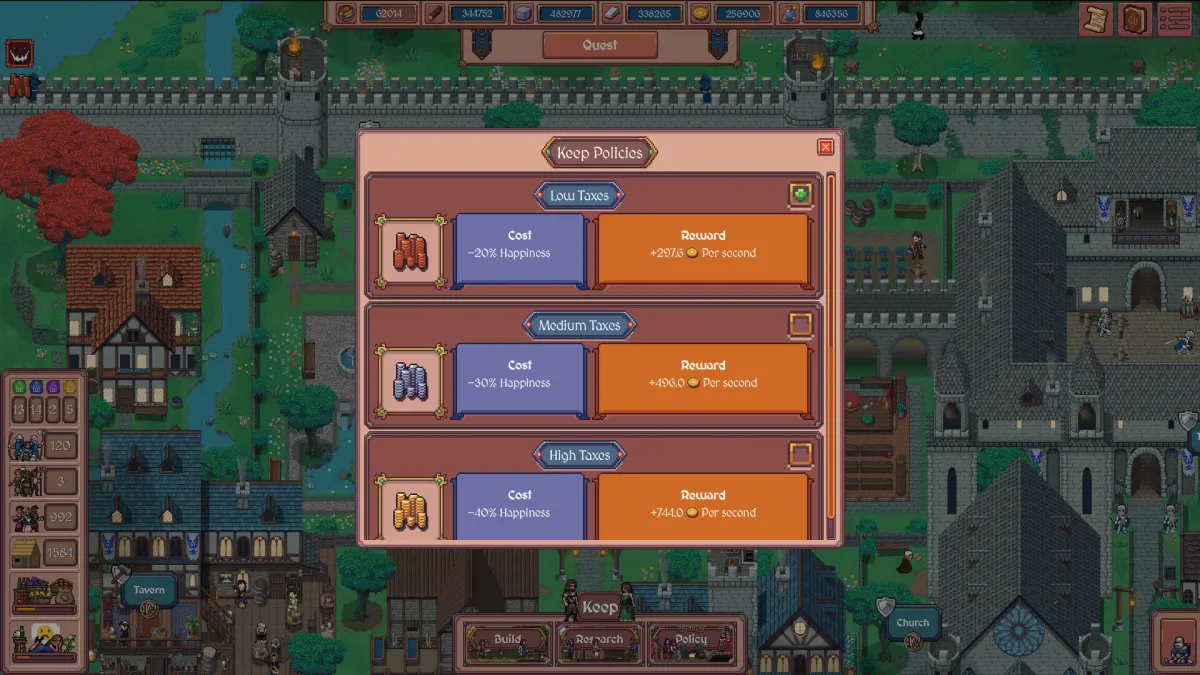
Alchemical labs and magical academies are also confirmed parts of the game's advanced building system. Official material does not establish their exact prerequisites or costs, so use the in-game research panel as the authority for the current version.
FAQ
Is research permanent in Hearth and Hamlet?
Yes. The official Steam description says the research tree permanently unlocks new technologies as your civilization advances.
What should I research first?
Start with research that improves the core resource loop or solves the bottleneck currently stopping your town. Early gathering improvements are a strong default, but the best next choice depends on your settlement's actual shortage.
Do I need a research tech to buy magic?
No. The developer confirmed that buying magic happens on the buying side of a trade expedition, not through any research node. The related Magical Trade Goods research (Magic Academy branch, with a level 3 Market requirement) is a separate unlock. The full walkthrough is in our trade guide FAQ.
When should I pursue alchemy or magic?
Treat alchemical labs and magical academies as later goals. Build toward them after food, housing, and core production are stable; the Academy branch's early entries (Enchant Weapons, Magical Trade Goods) need only Mage Tower level 2 plus a level 3 Market, while the siege-critical nodes (Consecrated Weapons, Battle Loot: Undead) are worth budgeting for before you build the Keep.
Can I track or pin a research goal like I can with buildings?
Yes — as of patch 1.1.0 (October 1, 2026), research pinning is in the game: research can now be pinned like buildings, and pinned research and buildings are saved and restored when you reload a save, so your session goal survives between play sessions. This answered a long-running request: the developer had acknowledged it early — “I've had a few people request this feature now, so I've moved it up on my priority list” (August 22, 2026) — and 1.1.0 shipped it alongside the save/restore behaviour players also asked for.
Sources
- Hearth and Hamlet on Steam (Phorust Studios) ↗
- Hearth and Hamlet Wiki — research catalogue (community, build 1.0.04) ↗
- Where is research to trade magic? - Steam thread with dev reply ↗
- ancient evil debuff - Steam thread ↗
- Hearth and Hamlet: Best Early Game Tips and Tricks (Into Indie Games) ↗
- Tips for trade? - Hearth and Hamlet Steam discussion ↗
- Broken task is to pay 40,000 gold - Steam thread with dev reply ↗
- 'Pin research, just like a building' - Steam thread with developer reply (Aug 22, 2026) ↗
- 'Is there a way to track research like you can track buildings?' - Steam thread (Sep 7, 2026) ↗