
What kind of game is this?
The official Steam page describes Hearth and Hamlet as a medieval citybuilder clicker that blends resource management, in-depth upgrade trees, and relaxing idle gameplay. In practice that means you are doing two things at once: actively deciding what to build, research, and staff next, and letting the settlement keep producing while you plan. It is a single-player game, and it ships with 24 Steam achievements.
The world is presented in pixel art — the official description highlights lakes, rivers, magical swamps, and faraway lands — and the building range runs from simple tents to taverns, castles, magical academies, and defensive fortifications. At the time of writing the game is listed at US$7.99 on Steam, supports Windows and SteamOS/Linux, and offers full audio and text in seven languages: English, Simplified and Traditional Chinese, German, Japanese, Russian, and Korean.
Steam user reviews stood at Mostly Positive — about 79% of roughly 2,300 reviews — when this page was last reviewed. That is context rather than a quality claim; for a launch-window game the number will keep moving.
If you have played idle or incremental games: expect a similar low-pressure loop, but with citybuilder decisions — worker allocation, layout, and research order — doing the heavy lifting.
The four kingdom stages
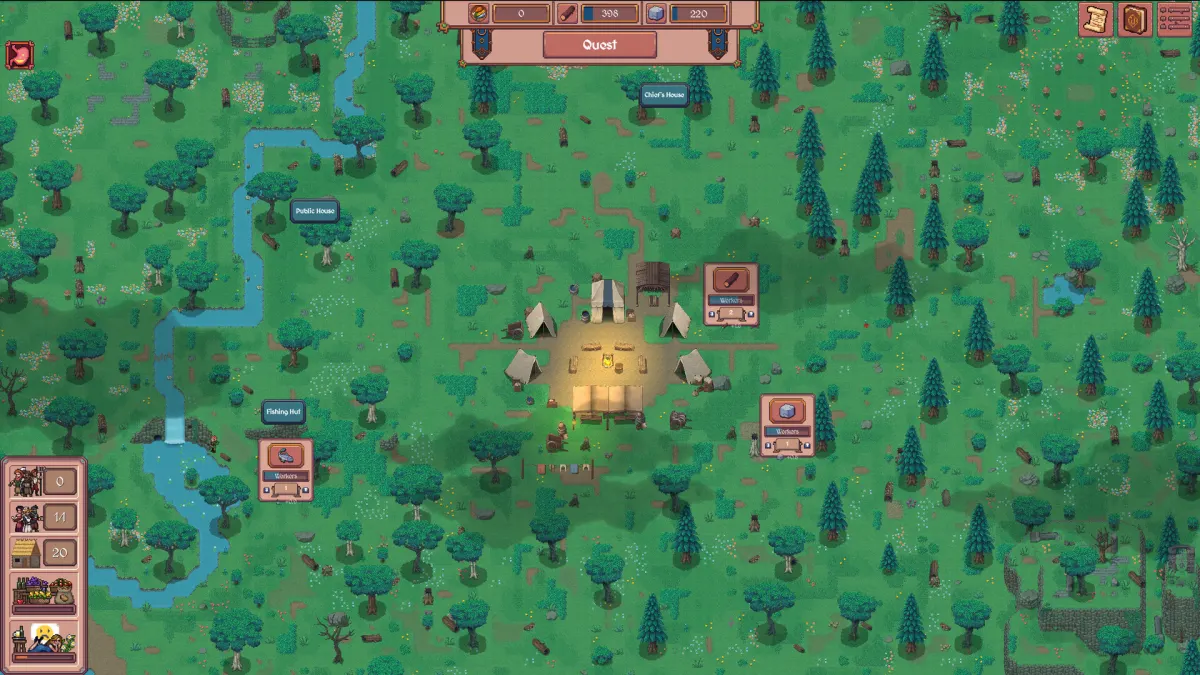
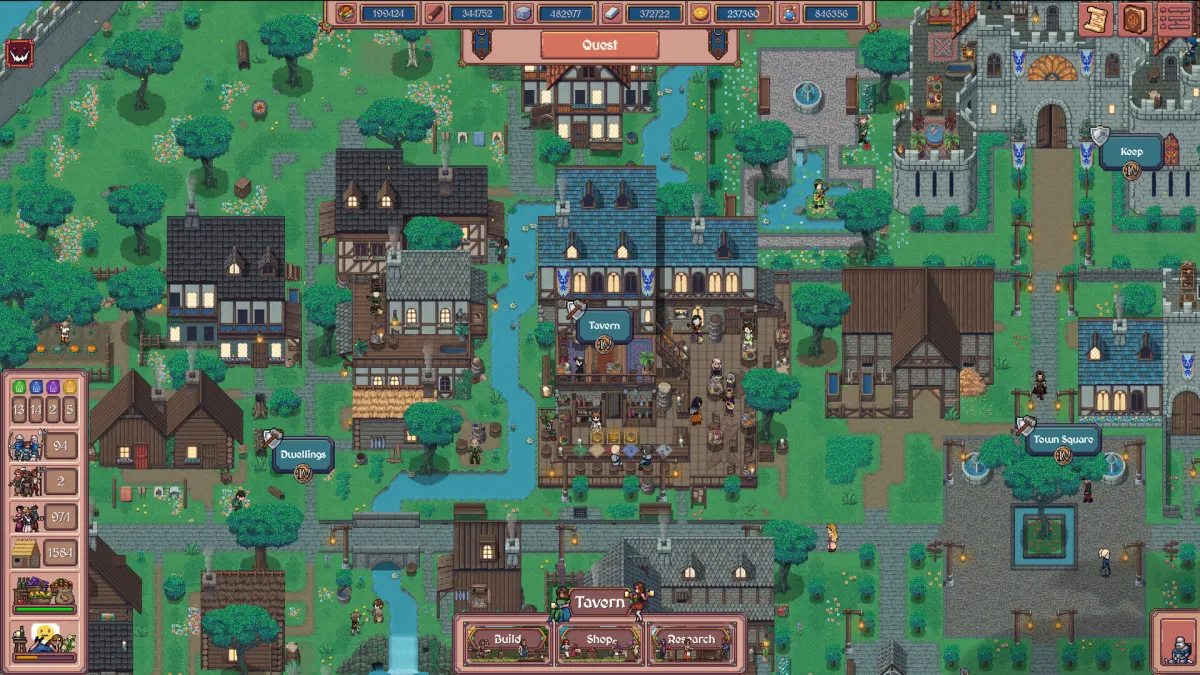
Hearth and Hamlet begins at a campfire and grows toward a full kingdom. The progression path is organized around four settlement stages: Campfire, Village, Town, and Kingdom. Treat each stage as a signal to strengthen the economy you already have, rather than a reason to expand immediately.
- Campfire: establish the first gathering jobs and follow the game's early direction prompts.
- Village: add workers and production without letting one material fall far behind the others.
- Town: research, laws, policies, and defense begin to matter alongside raw expansion.
- Kingdom: combine advanced buildings, trade, magic, and soldiers into a settlement that can support itself.
Progression rule: a stage upgrade is most useful after your current food and construction-material production can support the buildings it unlocks.
Core resources explained
The official Steam description identifies food, wood, stone, and gold as resources your population can gather. Iron also appears in early production planning in Muhammad Haris Umer's Into Indie Games walkthrough. Because unlocks and demand change as the settlement grows, the useful question is not which resource is universally best, but which one is currently blocking your next building, upgrade, or policy.
| Resource | Evidence | How to plan around it |
|---|---|---|
| Food | Named on the official Steam page | Keep production active while population and worker demand grow. |
| Wood | Named on the official Steam page | Maintain a share of labor for routine construction and upgrades. |
| Stone | Named on the official Steam page | Watch for it becoming the bottleneck on larger structures. |
| Gold | Named on the official Steam page | Review income alongside laws, policies, and later trade. |
| Iron | Included in Umer's early-game worker advice | Staff its production when the relevant facilities become available. |
Worker allocation basics
Umer recommends using an even split across food, wood, stone, and iron as an early baseline. That is a third-party strategy, not an official formula, but it is a simple way to prevent one production chain from being forgotten.
The same guide recommends abandoning that balance temporarily when one resource is holding up a structure or settlement upgrade: move labor toward the shortage, complete the immediate goal, and then restore a broader split. This makes worker allocation a control you revisit, not a one-time setup.
Practical loop: identify the blocked purchase, concentrate workers on its missing material, buy it, then rebalance before the next shortage develops.
Opening moves
The opening sequence below follows the recommendations published by Muhammad Haris Umer for Into Indie Games. It is a useful starting route, but it should be adapted to what your current save is short of.
- Follow the blue Guiding Arrow. Umer says it points toward the structures and facilities needed to get the first production chains running.
- Start from a balanced workforce. Spread workers across food, wood, stone, and iron, then focus them on a single shortage when a planned build is blocked.
- Prioritize research. The official page confirms that research permanently unlocks buildings, upgrades, policies, and magic; Umer recommends investing in it early instead of rushing isolated building upgrades.
- Upgrade resource structures before the next settlement level.Umer specifically recommends improving the fishing, lumber, quarry, and iron-production facilities before advancing the town square again — and recommends upgrading each of them at least once. According to his guide, those upgrades increase both the per-facility resource output and the resource storage capacity, so they pay twice.
- Prepare a defense. Once the Town Guards building is unlocked, Umer recommends training soldiers rather than postponing defense indefinitely. The official description confirms soldiers are used to protect the expanding realm.
Read the original advice in the Into Indie Games early-game guide.
Run your kingdom your way
Beyond construction and research, the official Steam page promotes a governance layer under the banner run your kingdom your way
: you set laws and policies, including taxation rules and worker rules that affect morale, and you decide when to draft citizens into the city guard. These civic choices are permanent steering decisions for your realm rather than one-off toggles.
- Taxation rules raise income, but worker morale is part of the same system — push rates only when you have a concrete purchase in mind.
- Worker rules influence how your population feels about their jobs; morale and output interact.
- City guard drafts convert civilians into protection for an expanding realm; the official description confirms soldiers exist to defend it.
The exact morale math is not published in the official material, so change one policy at a time and read the in-game feedback before committing further. Our tips page covers the happiness-versus-taxes trade-off in more detail, and the tech tree guide shows where policies sit in the research order.
After the coronation: what the ending means
The road from Campfire to Kingdom ends with your settlement's coronation as a monarchy. That is the designed conclusion of the campaign, not a stage you missed or a status you accidentally triggered - and when players asked directly what the game offers after it, the developer was candid. In the Steam thread Fun Once, Lack of Replayability, Phorust replied: Yes, I designed the game to be (mostly) a single playthrough experience and tried to price it appropriately.
No expansion has been announced, and when a player asked directly about new content on the game's Steam hub (the thread Any new content is planned?), the developer answered on September 5, 2026: the plan is to work through the small issues and improvements the community has highlighted first — “The past week or so has been spent purely on reducing the games VRAM footprint” — and “I intend to continue poshing [polishing] for some time. After that i'd love to add more content.” Things are moving slower now that he is back at his day job (Teacher), he noted, though he still fits in several hours of work each day. So more content is hoped for, not promised — and the honest answer to “what is next?” is still the rest of the same save. The difficulty ladder is the biggest lever: our difficulty guide compares all four modes and carries the developer's own Intense opening plan. The rule-based achievements come second - no-defeat runs and never trading with Ashenholt turn one completed kingdom into several planned reruns, and the achievements guide maps which rules can share a single save. And once a save is truly finished, our games-like-Hearth-and-Hamlet page picks up where the coronation leaves off.
FAQ
Why does my settlement become a monarchy?
Because that is where the campaign is meant to take you. Your settlement advances through the Campfire, Village, Town, and Kingdom stages toward the story's coronation, and the developer has described the game as a mostly single-playthrough experience - reaching the monarchy is the ending, not a penalty or a setting you tripped into. What follows is endgame cleanup rather than new story: difficulty completions and rule-based achievements, as covered in the difficulty and achievements guides.
Is Hearth and Hamlet an idle game?
It blends both. The official description pairs resource management and upgrade trees with relaxing idle gameplay, so production continues while you plan, but worker allocation and research decisions reward active attention.
How much does Hearth and Hamlet cost?
The game is listed at US$7.99 on Steam at the time of writing. Check the store page for current pricing and any regional differences.
What should I do first in Hearth and Hamlet?
Follow the blue Guiding Arrow and establish the production buildings it highlights. This is Umer's recommended opening route, not a forced objective order.
Which resources are confirmed in the game?
The official Steam page names food, wood, stone, and gold. Umer's guide also discusses iron production in the early economy.
Should workers always be split evenly?
No. An even split is a third-party baseline. When one material blocks your next upgrade, concentrate workers there temporarily and rebalance after the purchase.
Should I research or upgrade buildings first?
Research creates permanent unlocks, so it should remain active. Umer's route also upgrades the main resource structures before advancing the town square; the exact order depends on the shortage in your save.
Sources
- Hearth and Hamlet on Steam (Phorust Studios) ↗
- Hearth and Hamlet: Best Early Game Tips and Tricks (Into Indie Games) ↗
- Fun Once, Lack of Replayability - Steam thread with developer reply on the single-playthrough design ↗
- Any new content is planned? - Steam thread with developer reply on post-1.0.07 plans (Sep 5, 2026) ↗