
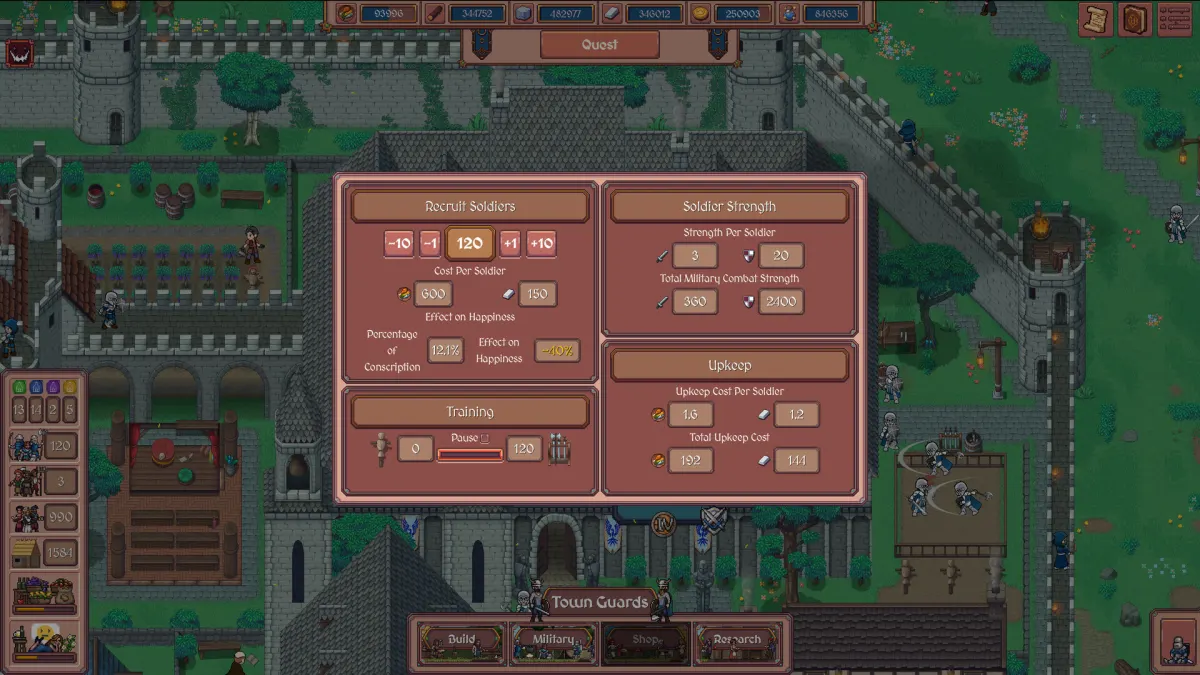
How soldiers work
The official store page keeps it broad: “Recruit soldiers as your realm expands to protect what you've built,” with city guard drafts listed among the policies that protect your population. What the page does not spell out — and what one answered Steam thread makes concrete — is that soldiers are recruited out of your working population. Every man-at-arms you field is a worker you no longer have at a woodcamp, farm, or market, and after a bloody battle you must reassign replacements yourself while the population slowly recovers.
The recruit-soldiers panel shows three numbers worth watching before any fight: total army strength, upkeep cost in gold, and a happiness penalty that grows as your army does. The same thread confirms the practical ceiling players aim for: keep enough soldiers that they no longer drag happiness below the threshold where growth stalls. On Intense, one player reported keeping the army just below that line so a lost battle hurts morale less than an unprotected town would.
A separate dev-answered thread settles two combat-math questions. First, research applies to existing soldiers instantly— “purchasing a new research should immediately change all the guards' stats. No retrain necessary.” Second, a normal critical hit is a x12 multiplier (the developer raised it from x10 because the difference was hard to see), and he notes the crit value “changes over time.” The same reply explains why in-game numbers sometimes look wrong: values carry hidden decimals — “it may look like you get 20 stone, but in fact it is 20.48” — and rounding those after multiplication produces odd figures on screen.
Rule of thumb: treat every soldier as both a sword and an absent pair of hands. Before recruiting past your happiness line, check which workposts will go unmanned, because combat losses arrive home as unfilled jobs, not as casualty reports.
Resolving battles
Steam reviews regularly call combat “unpredictable” and complain there is no way to tell why a fight was won or lost. The honest answer from every thread we reviewed: the game does not expose a strength-comparison screen before battle, so treat these community-sourced rules as the closest thing to a forecast.
| Factor | Effect per player reports | Confidence |
|---|---|---|
| Soldier count vs attacker count | The 120-soldier quest threshold implies attackers scale with your progress; losing players consistently report being under the marker. | Medium (one quest-confirmed number, several corroborating losses) |
| Army happiness penalty | Large armies push happiness down; one verified tip is sizing the army to sit just at the no-penalty line. | High (answered thread, repeatable) |
| Concurrent raid + army event | A skeleton warband arriving mid-battle can wipe your field army even when the Ashenholt force alone was beatable. | High (documented in the dev-replied bug thread) |
| Buffs and soldier stats | “Use buffs etc. to increase the stats of your soldiers” — quality partially substitutes for quantity. Research applies to existing soldiers instantly, no retraining. | High (dev-confirmed on stat updates) |
| Critical hits | A normal crit multiplies damage x12 (developer-raised from x10); the value scales up over time. | High (dev-stated, August 2026) |
Because outcomes are not itemized in a battle log beyond win or lose, the reliable habit is preparation rather than replay analysis: fight only above the quest's stated number, never with an active raid on the map, and confirm your happiness sits stable before committing.
Raids & defense timing
Two hostile event types exist in the mid-game window: wandering skeleton warbands — described in one thread as magical zombies that keep attacking until you deal with their source — and the scripted Ashenholt army offensive tied to the quest line. They can stack. The dev-replied bug thread documents a player activating the Ashenholt fight while skeletons were halfway to town; by the time the army arrived, the skeleton raid had eaten enough soldiers that the quest battle became unwinnable.
- Check the map before starting a quest fight. If any raid marker is active, wait it out. Consecutive battles with the same army are how under-strength losses happen.
- Recruit back to full strength after every defensive win. Losses convert directly into unfilled workposts (see buildings and workforce), so the economy hit is immediate even when the battle is won.
- Time big fights for stable happiness. The army penalty stacks with any post-raid unhappiness; recovering first keeps growth from stalling during the battle window.
How big do raids get?
Raids scale with your population. One Intense-mode player reports monster raids starting around the 200-population mark and growing from there; the sharpest data point comes from a max-difficulty player who met a skeleton wave of 68 attackers against 400 population — roughly one skeleton per six citizens — after clearing the same runs against goblins and rats with far smaller forces. Asked whether that wave was a bug, the developer answered that it is “intended to be very difficult,” but added he has “had a few reports that the early game is too challenge, especially the undead,” and is “considering turning it down slightly.” Treat skeleton-wave sizes as a live balance target: check the patch notes after each update before sizing your garrison.
Intense mode note: Intense is no longer the uncharted wall it was at launch — the developer has beaten it without losing a battle and published his full strategy, and the community has added staffing numbers for each wave. Our difficulty guide breaks the whole plan down; the short version is that early guard duty is still the real boss, but it now has a documented answer.
The 120-soldier Ashenholt fight
The quest “have 120 soldiers and fight the Ashenholt army” is the game's only publicly documented strength marker. One player described the fallout of attempting it under-strength: the battle was lost hard, and a reload afterwards produced a bugged, auto-completed version of the quest that the developer acknowledged and promised to investigate. A second player hit the opposite failure: after reloading a lost attempt, the quest became unstartable, with no way to summon the army again.
Before you activate it: confirm 120 soldiers on roster, no raid markers within marching time, happiness steady at your normal baseline, and a manual save from before the activation click. Both recorded quest failures happened in reloads of lost attempts, so the cheapest insurance is not needing one.
Winning this battle is also narratively significant: per the monarchy discussion thread, defeating a major army is what triggers the coronation sequence that turns your merchant city into a kingdom. Losing it (or exploiting the auto-complete bug) does not appear to block progression permanently, but both documented bug states left players stuck or confused — one saved a fraudulent win into their quest log, the other lost access to the fight entirely until a patch addresses the state handling.
Note: the developer first acknowledged the auto-complete report on August 22 as “a new one” to investigate. Patch 1.0.06 (August 29) then took a second pass — its notes list a fix for “a very rare but stubborn bug that could cause the Ashenholt army to fail to spawn, or the quest to be skipped after a failed attempt,” and the developer says he has “added in enough safeguards” to resolve it, though the bug was never reliably reproducible in his testing. The manual-save-before-activation habit remains the only guaranteed rollback.
The Ancient Evil horde siege
Build the Keep and the quest line walks you toward the cathedral — and, with no warning, into the hardest stretch of the run: the Ancient Evil. The Steam thread where players compare notes on it describes the pattern: a happiness debuff lands the moment the Keep goes up (players report it at roughly −50%; the developer has not published an exact number), food reads permanently zero while the debuff is active, and zombie hordes keep coming — one player counted a horde roughly every 30 seconds, each killing about 10% of his population. The Ancient Evil achievement (48.7% of players) is the milestone for surviving it.
This section is not the 120-soldier fight. The checklist above belongs to the scripted Ashenholt battle. The game itself tells you to hold 120 military for the horde siege too, but survivors call that number “the 120 recommended death trap”: hordes arrive back-to-back, and an army that just lost a third of its strength cannot refill in time. Their rule is at least 200 soldiers before you build the Keep.
Four community-tested rules separate the players who survive the event from the ones who reload it:
- Keep troops under 5% of population when idle. Below that line the army's happiness penalty disappears entirely, which is the only reason a 200-strong garrison is livable during the debuff. Players re-derived this rule in two separate threads, one calling it a fix that “works like a charm” even on lost battles.
- Rush Consecrated Weapons the moment the cathedral unlocks it. The developer's own verdict in the thread: “The enemy will become trivial once you research consecrated weapons.” The research sits behind the cathedral in the chain, so it is a two-step fix — players describe it as a knowledge check on whether you stockpiled the resources to buy it instantly. Per the community research catalogue it needs a Church at level 4 and adds +20% damage against Undead while preventing their revival (see our Undead-siege research section).
- Buy Battle Loot: Undead to turn the siege into income. The Mage-Tower research (level 3 per the catalogue) unlocks battle rewards from defeated Undead, and players report 50,000–100,000 gold and magic per fight once it is running — the same stretch the developer calls one of the most profitable parts of a run when handled well.
- A lost battle is not a lost run. The developer is explicit: “Each time you lose a battle, the enemy spawn will be smaller and less frequent,” and he states a soft-lock is not possible. Players still ask for a cooldown between hordes because the mid-event death spiral feels brutal — but the mechanic itself digs you out if you keep rebuilding between waves.
The developer returned to the thread on September 5 with the scaling rule behind the whole siege: “The larger your population, the more enemies you attract.” He also named the intended pressure valve, bluntly: “Simply turn down the difficulty if it is too annoying” — adding that being able to lower difficulty is what the option exists for. If the siege is crushing a run you care about, our difficulty guide compares the four modes and what each step up costs.
Combat FAQ
How many soldiers do I need to win battles?
The only publicly confirmed number is 120 for the Ashenholt quest army — and later scripted fights need more (Intense players report the third taxation event taking well over 120). Regular raids scale with your population, from roughly the 200-population mark, with documented skeleton waves of 68 attackers at 400 population. Fight above the marker, never under it, and replace losses before the next engagement.
Why did I lose workers after winning a battle?
Soldiers are recruited from your working population, so casualties show up as unfilled jobs even on a victory. A developer-endorsed Steam thread spells out the math behind it: defenders count toward your total population, and a new worker arrives each time population crosses the next threshold — roughly one worker per 14 population in the player-worked example the developer endorsed. If battle losses drop you back across a threshold, that worker is removed again; the developer confirmed the explanation, noting it “makes winning battles without taking losses more beneficial.” Reassign replacements manually once the population recovers; the answered Steam thread that established this also recommends sizing your standing army so its happiness penalty stays at zero during peacetime. Why the worker count sometimes rebounds: in a second, video-backed Steam thread, soldiers killed in the battle revive once it ends, so the population dip — and the worker removed at the threshold — comes back on its own after the fight (community-reported; the developer has confirmed the threshold math, not the revival detail). One player-reported wrinkle from the original breakpoint thread: the post-battle results screen can claim “0 civilian losses” while your working population still drops — treat the screen as about battle deaths only, and reassign workers regardless. Expect to hunt for the gap, too: the game gives no hint which job site lost its worker (a missing-warning gap players keep complaining about), so after a big battle, walk your production buildings and look for the one standing empty.
Why does my large army make people unhappy?
Army size carries a growing happiness penalty. Players keep a standing force just below the penalty line and only over-recruit for known fights, then release or absorb losses afterwards. Keeping a bloated peacetime army stalls population growth for no defensive gain.
Can skeletons attack while I fight the Ashenholt army?
Yes, and stacking both events loses fights by itself: the dev-replied bug thread documents an Ashenholt attempt that failed because skeletons arrived mid-battle. Wait out active raid markers before starting scripted quest battles.
My Ashenholt fight bugged after reloading. What now?
Two failure modes are documented: an auto-completed win after losing and a stuck state where the fight can no longer be started. Patch 1.0.06 (August 29) targeted both — the developer calls the safeguards he added a fix, offered save repairs via Discord for still-affected players, and asked anyone who hits it again to report with the save attached. If the quest auto-completed you keep progressing with a false win in the log; if it locks, use the pinned Bug Reports thread or Discord. The manual save before activating the battle remains the only guaranteed rollback.
How do I survive the Ancient Evil zombie hordes?
Before building the Keep: stockpile at least 200 soldiers (the in-game 120 number is a death trap for this fight) and keep them under 5% of population when idle so the happiness penalty stays at zero. Once the hordes start, rush the Consecrated Weapons research behind the cathedral — the developer says enemies become trivial with it — and buy Battle Loot: Undead to farm 50k–100k gold and magic per successful defense. If you lose a battle, the next spawn is smaller and less frequent (developer-confirmed), so the event is survivable even after a bad wave. Full breakdown in the Ancient Evil siege section above.
Is combat different on Intense difficulty?
The mechanics are the same but the margins are not: enemies jump sharply at population thresholds, and the early undead waves are tuned hard enough that the developer is considering softening them. It is beatable without losses — the developer has done exactly that and published the plan. Our difficulty guide carries the full strategy and completion-rate context.
Sources
- Hearth and Hamlet on Steam (Phorust Studios) ↗
- Some numbers seem of? - Steam thread with developer answers on crits and stats ↗
- Bug: Skeletons are too strong at maximum difficulty - Steam thread with developer reply ↗
- ancient evil debuff - Steam thread with developer replies on horde sieges and consecrated weapons ↗
- Hearth and Hamlet Wiki - research catalogue (community, build 1.0.04) ↗
- Losing workers even after winning a battle with 0 losses - answered Steam thread ↗
- Losing a Worker After Victory - Steam thread with developer-endorsed population-breakpoint explanation ↗
- Losing citizens/workers during the fight - video-backed Steam thread on soldier revival after battle ↗
- [Spoiler][BUG] Quest completes automatically even if you fail? - Steam thread with dev reply ↗
- Intense impossible without defeat? - Steam discussion ↗