
The four difficulty modes
Hearth and Hamlet ships with four difficulty modes: Gentle, Steady, Challenging, and Intense. The names come straight from the game's achievement list, which rewards a full completion on each mode. Exactly what each tier changes — enemy pressure timing, combat outcomes, economic slack — has not been documented publicly in detail. What is publicly measurable is how many players ever finish a run on each tier, from the official Steam achievement percentages:
| Mode | Completion achievement | Global unlock rate | How to read it |
|---|---|---|---|
| Gentle | Gentle Rule - complete the game on Gentle difficulty | 42.5% | Roughly two in five players finishes at least a Gentle run |
| Steady | Steady Hands - complete the game on Steady difficulty | 33.0% | Roughly nine points below Gentle - a modest but real step up |
| Challenging | Rising Challenge - complete the game on Challenging difficulty | 11.4% | The wall: two-thirds of Steady finishers never clear Challenging |
| Intense | Against the Odds - complete the game on Intense difficulty | 4.0% | The rarest completion achievement in the game |
Reading the funnel: unlock rates measure completed runs on that mode or stricter, not attempts. The steep 33.0% to 11.4% to 4.0% drop-off is the clearest public evidence that difficulty ramps sharply after Steady.
Which difficulty should you pick?
The honest answer depends on what broke your last run, and the official materials do not publish per-mode numbers for raids, defense checks, or economic pressure. What follows is calibrated against the completion funnel above and the achievements that bend run rules — treat it as orientation, then adjust to your own save:
- New to citybuilders or playing cozy: Gentle. A 42.5% completion rate is unusually high for a "finish the game" achievement; most players who want to see the ending will get it here.
- Comfortable with the loop, want some tension: Steady. The default middle path — noticeably harder than Gentle, still cleared by about one in three players.
- Confident planner chasing mastery: Challenging. This is where the funnel collapses to 11.4%. Expect hostile timings to punish slow openings.
- Completionists and masochists: Intense, ideally as a deliberate project after a successful Challenging run. At 4.0% completion it remains the rarest achievement in the game — but it is demonstrably beatable: the developer has finished it without losing a battle and posted his exact strategy, which our Intense section breaks down.
Special completion achievements
Two more achievements do not care which mode you pick — they change what a run is allowed to contain. Their unlock rates explain why so few players bother:
| Achievement | Official requirement | Global rate | What makes it hard |
|---|---|---|---|
| Flawless Victory | Win the game without suffering any defeats | 13.3% | One lost fight voids the run - the no-defeat challenge below |
| Ancient Evil | Tied to a specific end-game quest line | 48.7% | Listed for contrast: story-critical, not rule-restricted |
| Steadfast Resolve | Complete the game without ever trading with Ashenholt | 5.2% | Closes your most convenient market for the entire save (tracked per save, per the developer) |
No-defeat runs
At 13.3%, Flawless Victory is three times rarer than a Gentle completion but more than three times as common as an Intense one — it sits exactly in the band of "achievable with discipline." Notably, it now unlocks more often than Challenging completion (11.4%), which tells you most no-defeat hunters wisely pick an easier mode. The official store page gives you the defensive toolkit in one sentence: "Recruit soldiers as your realm expands to protect what you've built," reinforced by city guard drafts that defend the population. The discipline part is what the game will not do for you:
- Scout threats before they arrive. The timing log compounds across an entire save; a defeat in hour two voids the achievement at hour twenty.
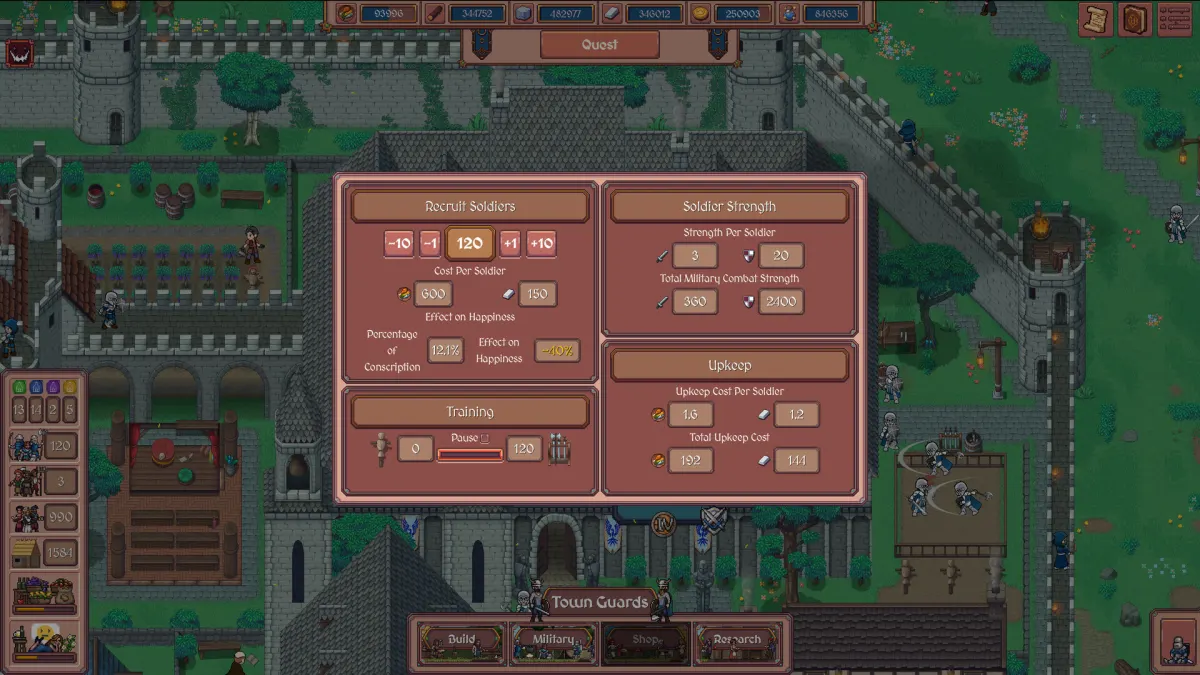
- Hold a standing army, not an emergency one. Soldiers take upkeep (the recruit panel shows cost per soldier and happiness effects), so budget them like infrastructure rather than firefighting.
- When a loss looks likely, reload before it resolves. Community reports indicate defeats are judged by outcomes; an interrupted fight before the losing tick preserves the run. This is player-reported behavior — verify it holds on your build.
- Garrison-first economy. Idle income keeps flowing during long defensive stands; starving the army to rush growth is how no-defeat runs die mid-way.
Intense mode strategy
Set expectations first: 4.0% of all players have finished Intense. It is the game's rarest completion achievement. Early in the game's life that number looked unreachably low — the thread's OP reported "after 8-12 restarts, passing the first 15 min after unlocking Town Guard [seems] possibly impossible.” Since then the picture flipped: several players have cleared it, the developer himself replayed the mode and says he “managed without difficulty and without losing any battles,” and he posted a complete strategy. What follows is that strategy, with the community's corroborating numbers.
Where Intense runs actually die
The developer identifies three losing points, and every player report in the thread maps to one of them:
- The first wave after the initial goblins. This is the opening wall the OP hit.
- The first waves after reaching 400 population — “especially if they're skeletons. Enemy difficulty jumps at certain thresholds.”
- The zombie invasion. Survivable, but only with military research kept current — our Ancient Evil siege section carries the community-tested troop counts and research route.
The developer's opening (point 1)
- Blacksmith soldier upgrades first — they require no upkeep, so stack them ASAP, plus most town guard upgrades.
- Run conscription at the high −20% happiness penalty (the step just before −30%). One player's math agrees: keeping the army at −20% while recruiting-and-disbanding is what carried them through.
- Skip Basic Training — it costs too much gold early; keep spare gold instead so you can buy extra training when a wave lands.
- Upgrade the town guard building — its level sets training speed, which decides how many soldiers you get before contact.
- Church tithes are “KEY” — soldiers are expensive to maintain, and tithes generate the gold that sustains them.
The 400-population gate (point 2)
Enemy difficulty scales with your population, so the developer managed growth deliberately: he held at 398 population with guard-house and blacksmith upgrades mostly maxed, absorbed the first attack easily, then added one building to cross 400 — and when the walls quest popped, immediately spent stored resources to raise both walls before the next wave. His verdict: “Walls are overpowered.” A community run confirms the mechanic from the other end: monster raids begin around 200 population and scale with it, so keeping population low until buildings and critical research are finished is a legitimate Intense playbook.
Two community-reported levers make that playbook actionable (from a September 2026 highest-difficulty thread; the developer has not confirmed either one):
- Defer or skip dwelling upgrades. Attack-wave size scales with population, so one finisher deliberately left dwellings alone after unlocking the farm — “fewer people results in smaller waves” — and completed the mode with dwellings still at level 2.
- Run food in the red to freeze growth. Population does not grow while food is negative, so one player kept it deliberately in the red through the first third of the run, raising it only for a specific upgrade and dropping it back — “no problems at all.”
Both levers only manage the rule the developer confirmed in our Ancient Evil siege section: the larger your population, the more enemies you attract.
The zombie invasion (point 3)
Keep blacksmith military research maxed, keep a high-level guard house training, and run taxes that can afford the army. Call to Arms rebuilds troops fast after bad RNG, healing potions carry High-difficulty fights, and the developer calls consecrated weapons a “cakewalk” once researched — he notes this stretch can be one of the most profitable parts of the run if handled well.
Force composition and economy
- Quality beats quantity: “40 well-upgraded soldiers are much better than 80 soldiers half as strong” — and 10 strong soldiers retrain faster than 20 weak ones.
- Priority order: defense technology and soldiers before expansion; strong gold and iron production (tithes and taxes) to sustain them.
- Quest-fight warnings from players: the third taxation event needs way more than 120 troops — one player lost a 100,000-gold defense with roughly 65 soldiers against 105 skeleton warriors despite maxed upgrades. Our combat guide covers the garrison math.
Watch the patch notes: the developer has said twice (Aug 27 and Aug 30) that he may tune the mode down slightly, and is specifically considering softening the early-game undead. If that lands, the strategy above still applies but the pressure drops — re-check this page after the next patch.
Difficulty FAQ
Can you change difficulty mid-run?
The game has never documented a mid-run difficulty switch, so plan your run around the choice made at save creation. Patch 1.1.0 (October 1, 2026) adds the strongest signal yet that lowering is possible mid-run: the game now warns you when lowering the difficulty would affect the completion achievements. A warning like that only matters if downshifting an existing save is something players can do — and it exists precisely because doing so can forfeit the mode-completion achievements. Do not count on downshifting to keep an achievement run alive.
Do lower difficulties lock achievements?
No — 19 of 24 achievements (everything except the five mode or rule-dependent completions) can be earned on any difficulty. Gentle Rule alone is at 42.5%, so plenty of players collect most of the list without ever leaving Gentle. Since patch 1.1.0 (October 1, 2026), the game also warns you at the moment you lower the difficulty if the change would affect the completion achievements.
Which difficulty should my first run be?
Gentle if you want to learn systems without defense pressure; Steady if you have citybuilder experience and want some tension. The 9-point drop between their completion rates makes Steady a genuine step up rather than a token one.
Is the game supposed to be easy? Will it get harder?
Relaxing is the design, and no rebalance has been announced. Answering the “too easy” thread on Steam (September 5, 2026), the developer explained the difficulty options exist because playtesters described his original Challenging difficulty as “WAY to hard” — the options let people play as they prefer, with this game focused on being a “Relaxing” experience. He agrees it stops being hard once you know the systems (his own hardest-difficulty run lost no battles) and says he would love to explore a more challenging game in the future, but no balance tuning for this one has been announced. If you want more tension, the answer is the Intense mode above, not a patch.
Is Intense actually beatable?
Yes — definitively now. The developer has beaten it without losing a single battle and published the exact strategy (see the Intense section above), and several players have followed it to a clear. It remains the rarest completion at 4.0%, and the opening after Town Guards is still where most attempts die. Read the strategy first; blind attempts are what produced the 8-12 restart stories.
Does Flawless Victory require Intense?
No — it only requires winning without suffering any defeats, on any mode. Most players chase it on Gentle or Steady where threat timing is forgiving. The two hardest challenges stack only if you deliberately combine them.
Sources
- Hearth and Hamlet on Steam (Phorust Studios) ↗
- Intense impossible without defeat? - Hearth and Hamlet Steam discussion ↗
- too easy - Steam thread with developer reply on difficulty design intent (Sep 5, 2026) ↗
- Highest Difficulty Guide - Steam thread with community population-control tactics (Sep 12, 2026) ↗